IAB’s Rothenberg down under

Some interesting thoughts in this conversation between IAB CEO Randall Rothenberg and Ben Shepherd of Australia’s Business Spectator.  While the whole discussion is interesting, I’d like to call out in particular Rothenberg’s assessment of the top 3 challenges facing IAB and the industry at large.

I think he has them right.

The swirling privacy issues don’t impact Brand.net (we don’t do BT for a variety of reasons – more about that on this page soon), but as BT becomes ubiquitous privacy issues represent a significant overhang to many other players and the industry overall.

The other two issues he mentions, though – measurement standards and branding – are near and dear to us at Brand.net.  It may not be immediately obvious, but these two issues are intimately related.  Online DR is easier and bigger than branding online today.  This is partially because investment in technology has disproportionately focused on DR, but measurement standards are a major factor as well.

The standard for DR is easy: CPA.  Attribution models are a topic of constant discussion (especially given some of Atlas Institute’s work), but for DR at least the goal metric is very clear.  For brand advertisers, who may not have near-term direct sales objectives and/or who are generating 95+% of their revenue with offline sales, it’s not so simple.  These advertisers need a variety of measurement approaches to understand the impact of their online campaigns on attitudes, online activities and offline sales.

Brand.net offers a complete portfolio of brand measurement capabilities and our platform is designed to deliver media that drives results, however they are measured.
Echoes of Exchange 3.0

Just a quick note pointing to a short, but interesting post today that echoes my recent article in Ad Age.  Clearly Pete Kim and whoever he was talking to understand that it’s not all about DR.  Kudos to them.

Again, today’s re-energized battle for display is just warming up.  The long-term winner will be the one that provides brand-focused capabilities on top of the evolving supply platforms to help brand budgets follow audiences online.

Brand.net’s breakthrough

Interesting article by Joe Mandese on MediaPost this AM.  “Unsavory adjacencies” (which would be a great band name by the way) are indeed a huge concern for the largest brand advertisers as they ramp up their online investments.  That’s why Brand.net pioneered preventative page-level content filtering with the launch of SafeScreen almost a year ago.  Abbey Klaassen at Ad Age and Laurie Sullivan at MediaPost both covered the launch back in February.

Since then, while others have been in development, we’ve been busy protecting our customers.  In the past year, SafeScreen has provided 8 of the top 10 CPGs, dozens of other Ad Age 100 spenders and each of the top agency holding companies with the cleanest inventory available on the web, preventing millions of “unsavory adjacencies” each week.

While we’re on the topic, I will reiterate the point I made in my iMedia article a couple months back – that quality is a page-level issue, not a site-level issue.   The reason I bring this up is that in order to do any sort of page-level quality filtering, it’s necessary to know exactly which pages are requesting ads – i.e., which pages need filtering.  This is a very difficult challenge due to common usage of iframes by publishers.  This recent blog post provides a great background on iframes for the uninitiated.

SafeScreen works because Brand.net does the buying and the filtering.  So if we want to buy from a publisher that uses iframes we can take steps in advance to make sure we have accurate page-level visibility so SafeScreen can work.  The recently announced quality assurance products seem to suggest in their marketing claims that they can be dropped in front of a random, arbitrary ad buy and ensure safety.  This simply isn’t technically possible due to the prevalence of iframes.

Buyers considering these “stand-alone” solutions should ask hard questions.  If they do they will find they aren’t going to be nearly as safe as the marketing suggests.

2010 – the year of CPG?

Interesting post from Cory Treffiletti on Mediapost this AM.  He’s predicting that 2010 will be a big year for CPG spending online, driven by better measurement capabilities to prove the offline sales impact of online spend.

I agree.

Brand.net is a clear leader in this area, delivering strong, proven ROI results on web-wide campaigns for some of the biggest CPG brands on the planet.  These were not niche studies.  The average campaign size measured was >$250K, running across dozens of sites.  So Brand.net offers the viable, scalable solution Cory envisions to tie online ad exposure to offline sales.  We offer it today and have proven that it works.

Now if you’ll excuse me, I need to go call Cory to collect that budget he promised.  It’s shaping up to be a great 2010!

The Click isn’t just resting (redux)

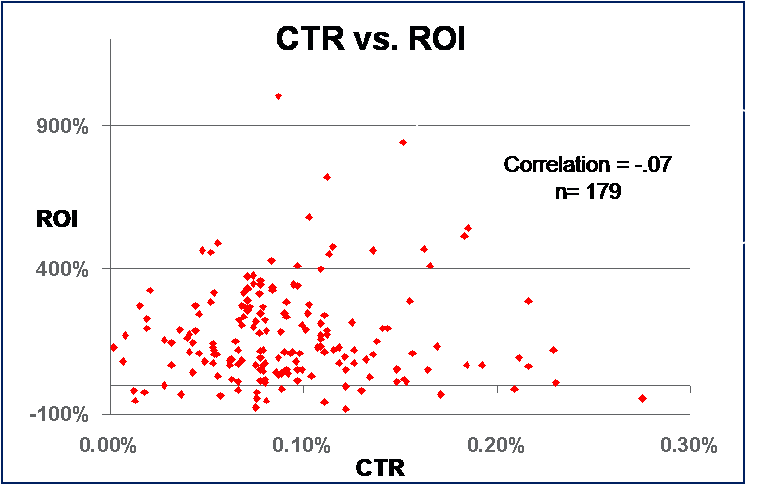
Another great article on the shortcomings of the click as a metric this morning, this one from Josh Chasin, Chief Research Officer of comScore.  In addition to the points Josh makes in his article, I would also recall a recent post of my own where I show that CTR has been almost completely uncorrelated with ROI in our offline sales lift studies.  Since that post I heard a talk by Nielsen Online CEO John Burbank where he presented a much broader dataset (graphic below) that showed similar lack of correlation between CTR and the metric that really matters:  did your online campaign ultimately sell more product in stores.

picture1

RIP the click.

Great minds think alike

Nice short piece this AM from Peter Kafka of allthingsd re: Microsoft’s plans to enter the Exchange 2.0 landscape with a re-tooled AdECN.  Very much in line with my post earlier this week in Ad Age.  As I wrote, the next 12-36 months will be interesting indeed…

In Search of Exchange 3.0

I thought readers of this blog may also be interested in my guest post for Ad Age, where I give a brief history of the evolution of the display advertising exchange ecosystem and suggest what I believe is the next step.  This post for Ad Age follows up on my previous post here.

As always, let me know what you think!

The click isn’t just resting…

An article in today’s eMarketer nicely summarizes some recent comScore / Starcom USA research showing that fewer and fewer users are clicking on ads and those clicks are concentrated in an ever smaller share of the user base.  Not good news for fans of CTR as an “optimization” metric – and there are still too many of these.

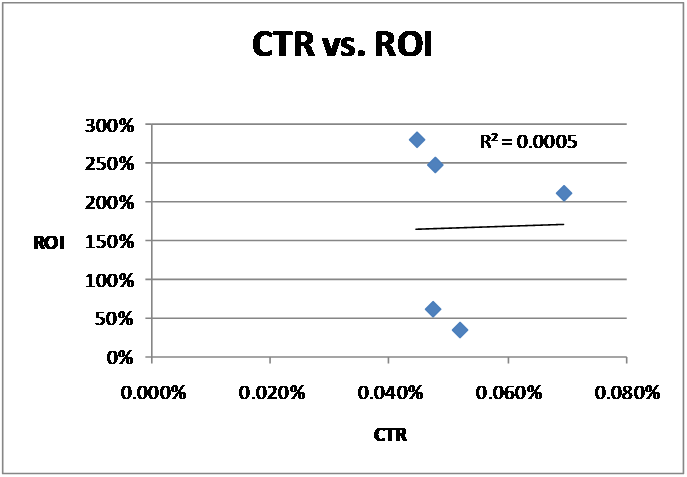
The article includes a priceless quote from John Lowell, Starcom USA SVP and director, research and analytics, “A click means nothing, earns no revenue and creates no brand equity. Your online advertising has some goal—and it’s certainly not to generate clicks.”  Don’t mince words John.  Tell us what you really think.  We’ve seen the same with our own offline sales measurements, by the way.  CTR is not even remotely correlated with offline sales lift or associated campaign ROI.  Here’s an example of the lack of correlation from some recent campaigns:

CTR vs. ROI

Reading Lowell’s quote and considering the fact that this is still even a topic for discussion reminded me of Monty Python’s famous Parrot Sketch.

Advertiser: “I know a dead metric when I see one and I am looking at one right now.”

DR Network: “No, no it’s not dead.  It’s just resting.”

A very smart publisher (redux)

Another tremendously insightful article yesterday from Michael Zimbalist of NYT.  This guy is sharp.  His analysis of the situation is dead on and I completely agree with the rough bucketing of potential outcomes and associated implications for the various ecosystem players.

However, I want to make it clear that the key to Zimbalist’s positive outcome scenario (scenario 3) is the emergence of capabilities that aren’t widely available today.  As Dan Ballister wrote in his comment to the article, “If buyers are going after audience in real-time auctions, will they make peace with having to forfeit control over ad environment and delivery predictability?  What good is it to reach your audience when they don’t want to be found, or to only run 15% of your back-to-school campaign on time because you kept getting outbid?”

Well put.

In order for Brand marketers to fully leverage the emerging exchange ecosystem they will need sophisticated technology for page-level quality filtering, pricing & delivery prediction, R/F & composition management, delivery smoothing, offline impact measurement, etc.   In case it’s not obvious, that’s a very different toolset than the fine targeting and CPA-driven optimization engines of which the market has produced scores of copies thus far – on both the demand side and the supply side.

Stay tuned for some more in depth thoughts on this topic shortly.

Mike Linton on shiny objects

Approaching the anniversary of our first “official” publication, I wanted to highlight a recent, thought-provoking article by Mike Linton, former CMO of eBay and Best Buy.

Linton raises some very important points about the limitations of some of the new capabilities enabled by the Internet in the context of the less flashy businesses that spend the majority of marketing dollars.  As he puts it, “Maybe the paper towel Facebook community or lawn fertilizer Tweets might work for you, but I doubt it”.  I couldn’t have said it better myself.

The higher level message here is not that the Internet isn’t an extremely important media vehicle.  It unquestionably is.  But we shouldn’t abandon everything we’ve learned as marketers over the years in our pursuit of the latest in a never-ending series of shiny objects.  Some of today’s shiny objects will become valuable, scalable tools, but many more of them won’t.

Linton didn’t get to be CMO of eBay by being an internet skeptic.  I think marketers would be wise to consider this perspective.