For Brand.net, Quality is more than an Undertone.

Catching up on my inbox, I noticed an interesting article from Undertone’s Alan Schanzer last week on AdExchanger.  Credit to Mr. Schanzer for trying to help media buyers differentiate between networks; it’s a crowded market with lots of overlapping claims and capabilities.  Unintentionally, however, his article does more to clarify how little first generation ad networks can do to maintain media quality and protect clients’ brands than it does to provide useful advice for the media buying community.

Mr. Schanzer claims that, “when selecting a network, business practice transparency is far more important than site transparency” and focuses the reader on two bad business practices that site transparency does not prevent:  URL padding and daisy chaining.   He’s correct of course that site transparency doesn’t address either issue.  But it’s not exactly news that lying about site breadth or buying in a completely uncontrolled manner are bad business practices.  If avoiding them is even enough to be table stakes then it’s a low limit game.  Sophisticated buyers demand (and get) a lot more from their most important partners, and have for years.

Mr. Schanzer is 100% correct that, “a site list alone will not protect your brand”.  But he doesn’t get down to the real threat to your brand:  objectionable content.  Nor does he discuss the fact that objectionable content is not just a site-level (publisher) problem, it is a page-level problem (i.e., there are pages on the very best publisher sites that have objectionable content, which can arise in an instant by way of user generated comments) and because it is a page-level problem it takes serious technology to solve.  That’s why Brand.net has invested millions of dollars over the last 18 months in our pioneering page-level filtering platform, SafeScreen, which launched in Q109.  That’s also why I wrote a detailed article for iMedia in September on the criticality of ensuring quality at the page-level and posted a more recent follow-up that discusses some major problems with emerging 3rd party technologies that claim to address this issue.

Having said all of that, I am surprised that late in 2009 Mr. Schanzer would want to draw attention to the weakness of a site-based approach to managing quality.  Particularly when Undertone’s quality “guarantee” is framed 100% in terms of site selection.  Read it carefully.  Undertone does not guarantee that it will keep clients’ ads away from objectionable content.  It merely guarantees that clients’ ads won’t run on a site that is not certified as an Undertone Quality Publisher (UQP).  This commitment is almost meaningless because (at least on this page) UQP is undefined outside of a few vague criteria.  As written, Undertone could call a “professionally produced and aesthetically desirable” porn site an UQP and not payout under the “guarantee”.

Of course Undertone would not act in such bad faith, but by framing its quality “guarantee” in terms of site selection and saying nothing about page-level quality, it reveals either a fundamental misunderstanding of the key quality issue that sophisticated media buyers are focusing on today, or the lack of technology required to deliver a best in class solution. It’s pretty clear it’s the latter, because at the bottom of the same page the fine print specifically and explicitly carves out a safe harbor for ads that end up next to objectionable content on pages of UQPs.  In other words, Undertone is saying that if they place your high end beauty, food product or premium diaper ad next to the F-word (or worse) in a user comment that appears on a top women’s site, they’ve successfully completed their job as your media partner.  At Brand.net we certainly wouldn’t want to try to explain that to one of our customers and SafeScreen means we won’t have to.

I propose a New Year’s Resolution for the industry:  let’s elevate the dialog from trading marketing claims of little or no practical utility to active discussion and execution of the cutting edge solutions that sophisticated clients demand and deserve.
IAB’s Rothenberg down under

Some interesting thoughts in this conversation between IAB CEO Randall Rothenberg and Ben Shepherd of Australia’s Business Spectator.  While the whole discussion is interesting, I’d like to call out in particular Rothenberg’s assessment of the top 3 challenges facing IAB and the industry at large.

I think he has them right.

The swirling privacy issues don’t impact Brand.net (we don’t do BT for a variety of reasons – more about that on this page soon), but as BT becomes ubiquitous privacy issues represent a significant overhang to many other players and the industry overall.

The other two issues he mentions, though – measurement standards and branding – are near and dear to us at Brand.net.  It may not be immediately obvious, but these two issues are intimately related.  Online DR is easier and bigger than branding online today.  This is partially because investment in technology has disproportionately focused on DR, but measurement standards are a major factor as well.

The standard for DR is easy: CPA.  Attribution models are a topic of constant discussion (especially given some of Atlas Institute’s work), but for DR at least the goal metric is very clear.  For brand advertisers, who may not have near-term direct sales objectives and/or who are generating 95+% of their revenue with offline sales, it’s not so simple.  These advertisers need a variety of measurement approaches to understand the impact of their online campaigns on attitudes, online activities and offline sales.

Brand.net offers a complete portfolio of brand measurement capabilities and our platform is designed to deliver media that drives results, however they are measured.

Brand.net’s breakthrough

Interesting article by Joe Mandese on MediaPost this AM.  “Unsavory adjacencies” (which would be a great band name by the way) are indeed a huge concern for the largest brand advertisers as they ramp up their online investments.  That’s why Brand.net pioneered preventative page-level content filtering with the launch of SafeScreen almost a year ago.  Abbey Klaassen at Ad Age and Laurie Sullivan at MediaPost both covered the launch back in February.

Since then, while others have been in development, we’ve been busy protecting our customers.  In the past year, SafeScreen has provided 8 of the top 10 CPGs, dozens of other Ad Age 100 spenders and each of the top agency holding companies with the cleanest inventory available on the web, preventing millions of “unsavory adjacencies” each week.

While we’re on the topic, I will reiterate the point I made in my iMedia article a couple months back – that quality is a page-level issue, not a site-level issue.   The reason I bring this up is that in order to do any sort of page-level quality filtering, it’s necessary to know exactly which pages are requesting ads – i.e., which pages need filtering.  This is a very difficult challenge due to common usage of iframes by publishers.  This recent blog post provides a great background on iframes for the uninitiated.

SafeScreen works because Brand.net does the buying and the filtering.  So if we want to buy from a publisher that uses iframes we can take steps in advance to make sure we have accurate page-level visibility so SafeScreen can work.  The recently announced quality assurance products seem to suggest in their marketing claims that they can be dropped in front of a random, arbitrary ad buy and ensure safety.  This simply isn’t technically possible due to the prevalence of iframes.

Buyers considering these “stand-alone” solutions should ask hard questions.  If they do they will find they aren’t going to be nearly as safe as the marketing suggests.

2010 – the year of CPG?

Interesting post from Cory Treffiletti on Mediapost this AM.  He’s predicting that 2010 will be a big year for CPG spending online, driven by better measurement capabilities to prove the offline sales impact of online spend.

I agree.

Brand.net is a clear leader in this area, delivering strong, proven ROI results on web-wide campaigns for some of the biggest CPG brands on the planet.  These were not niche studies.  The average campaign size measured was >$250K, running across dozens of sites.  So Brand.net offers the viable, scalable solution Cory envisions to tie online ad exposure to offline sales.  We offer it today and have proven that it works.

Now if you’ll excuse me, I need to go call Cory to collect that budget he promised.  It’s shaping up to be a great 2010!

In Search of Exchange 3.0

I thought readers of this blog may also be interested in my guest post for Ad Age, where I give a brief history of the evolution of the display advertising exchange ecosystem and suggest what I believe is the next step.  This post for Ad Age follows up on my previous post here.

As always, let me know what you think!

The click isn’t just resting…

An article in today’s eMarketer nicely summarizes some recent comScore / Starcom USA research showing that fewer and fewer users are clicking on ads and those clicks are concentrated in an ever smaller share of the user base.  Not good news for fans of CTR as an “optimization” metric – and there are still too many of these.

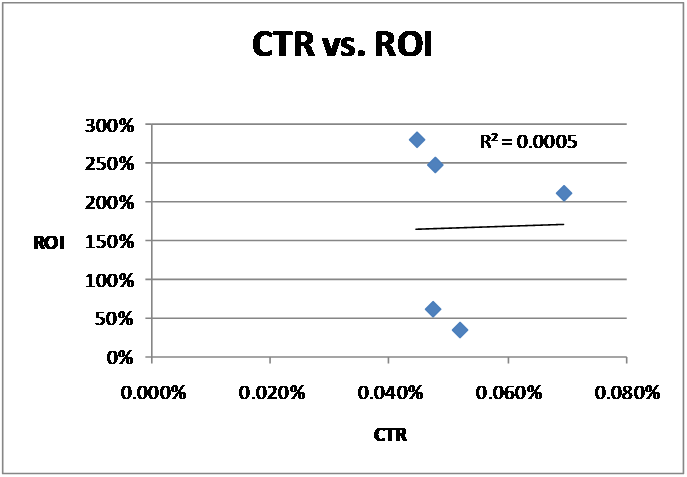
The article includes a priceless quote from John Lowell, Starcom USA SVP and director, research and analytics, “A click means nothing, earns no revenue and creates no brand equity. Your online advertising has some goal—and it’s certainly not to generate clicks.”  Don’t mince words John.  Tell us what you really think.  We’ve seen the same with our own offline sales measurements, by the way.  CTR is not even remotely correlated with offline sales lift or associated campaign ROI.  Here’s an example of the lack of correlation from some recent campaigns:

CTR vs. ROI

Reading Lowell’s quote and considering the fact that this is still even a topic for discussion reminded me of Monty Python’s famous Parrot Sketch.

Advertiser: “I know a dead metric when I see one and I am looking at one right now.”

DR Network: “No, no it’s not dead.  It’s just resting.”

A very smart publisher (redux)

Another tremendously insightful article yesterday from Michael Zimbalist of NYT.  This guy is sharp.  His analysis of the situation is dead on and I completely agree with the rough bucketing of potential outcomes and associated implications for the various ecosystem players.

However, I want to make it clear that the key to Zimbalist’s positive outcome scenario (scenario 3) is the emergence of capabilities that aren’t widely available today.  As Dan Ballister wrote in his comment to the article, “If buyers are going after audience in real-time auctions, will they make peace with having to forfeit control over ad environment and delivery predictability?  What good is it to reach your audience when they don’t want to be found, or to only run 15% of your back-to-school campaign on time because you kept getting outbid?”

Well put.

In order for Brand marketers to fully leverage the emerging exchange ecosystem they will need sophisticated technology for page-level quality filtering, pricing & delivery prediction, R/F & composition management, delivery smoothing, offline impact measurement, etc.   In case it’s not obvious, that’s a very different toolset than the fine targeting and CPA-driven optimization engines of which the market has produced scores of copies thus far – on both the demand side and the supply side.

Stay tuned for some more in depth thoughts on this topic shortly.

Are you actually buying what you think you’re buying?

Great article by Mike Shields in MediaWeek yesterday. According to the article, Tremor Media was running ad for major brands that were a) in-banner video as opposed to pre-roll, b) below the fold and c) adjacent to questionable content.

I want to highlight two separate issues in the context of this article: quality control and credibility.

Quality control is something that has been top priority for Brand.net since inception, because it was the number one concern of our branding-focused clients. I have written extensively on this topic and Brand.net’s SafeScreen platform is the premier quality assurance platform on the web, providing page-level filtering to ensure quality for every impression that runs through the Brand.net network. The monitoring capabilities Adam Kasper mentions in the article can be useful, but it’s far better to prevent quality incidents in the first place. He’s dead on when he says that quality control is the ad network’s responsibility. Unfortunately, too often that responsibility is not fulfilled.

On my second point, ad networks at large have a reputation for not always being completely honest with clients. This is another issue I’ve written on in the past. In response to this particular incident, Shane Steele, Tremor’s VP marketing, was quoted saying, “It’s a very nuanced space, which makes it complicated”. Actual pre-roll video is indeed more complicated than display, but the ads at issue here were display ads. They just happened to be running video creative. So answers like this don’t help build credibility for networks and they certainly don’t help build the trust that’s so essential for major brands to fully leverage the medium.

Tod Sacerdoti summed it up well when he said, “There is a gap between what an advertiser thinks they are buying and what they are [actually] buying.” This gap occurs far too often today and it needs to be closed before the medium can fully mature.

“Offline Metrics” Work Online Too

Still digging out of my baby-induced blog backlog and came across an interesting MediaPost article by Adam Kasper of Media Contacts.  He basically poses a challenge to the online media industry to pull together and come up with an online GRP.  This theme is echoed in a recent (and fantastic) whitepaper from Microsoft’s Atlas Institute, which gives a more comprehensive treatment along with some practical suggestions.

Development and use of online metrics comparable to those routinely used in offline media is an extremely important topic.  As Kasper points out, comparable metrics make it easier for marketers to follow their audiences online.  That’s for sure (and we still have a lot of work to do there), but there are also some practical reasons why these tried and true top of the funnel metrics are as important online as they are offline.  First off, keep in mind that nearly 90% of retail commerce still occurs offline (even higher in some key ad categories like CPG).  Offline sales simply do not generate the same volume of online-actionable direct metrics that, for example, a company like NetFlix does.  So there’s a real practical limit to the in-flight optimization that can be done for marketers whose supply chains terminate offline.  Concepts like composition, reach and frequency are still tremendously useful tools in this environment.  Secondly, for many campaigns more precise targeting may not valuable and/or may not be available at scale.  Privacy issues aside, I’m not sure that “laundry detergent purchase intender” targeting gets you much further than “women, 25-54 with children at home” does.  But I am sure that it’s more expensive and offers smaller scale.  These points are just a brief treatment of an issue I have written on at length in the past.

The bottom line is that, even though less sexy, these “offline metrics” can be just as useful online and we shouldn’t be ashamed of using them.  Brand.net has shown that quality media, tight management of frequency, maximized composition and full budget delivery drive measurable results at the cash register.  That’s sexy enough for me.

The Bottom Line is Online Ads Work for Branding and Sales

Last week MediaPost picked up a press release on some comScore research showing that online ads can be effective in driving offline sales.  Just as effective as TV in fact.  This came as no surprise to us at Brand.net.  We have seen similar results in our work with clients measuring offline sales impact in response to online campaigns.

This recent release apparently builds on some earlier research discussed by comScore Chairman Gian Fulgoni in his keynote to the OMMA metrics conference in San Francisco at the end of July (covered in another MediaPost article, from which I borrowed my headline).  In his remarks, Fulgoni gave some rough treatment to CTR (similar to a post last week from Cory Treffiletti).  I was on panel at the same OMMA conference.  The panel focused on Brand measurement and the moderator (Dan Beltramo from Vizu) asked each of the panelists to answer a few questions to get the conversation started. One of the questions was, “What is the most misused metric for Brand Campaigns?”. All 4 panelists including yours truly answered, “CTR.”, to which Dan readily agreed. The fact is CTR isn’t correlated with attitudinal measures that Vizu focuses on. Nor is it correlated with ROI as measured by offline sales impact vs. online campaign spend.

The moral of the story is that well-executed online advertising delivers results throughout the marketing funnel and those results come through in the metrics, when the metrics applied are meaningful.