Crack isn’t just a waste of time. It’s bad for you too

There’s definitely no shortage of research showing the irrelevance of clicks as an indicator of online campaign value.  Our own experience shows it and Nielsen data proves it.  This probably has a lot to do with the fact that the folks doing the clicking are a small portion of population and demographically far from the top of most advertisers’ target lists.   None of this is news, yet there remains a surprising (shocking?) amount of attention paid to click-based “optimization” of campaigns.  Perhaps it’s the crack-like allure that Cory Treffiletti from Catalyst SF discusses in a fun piece from last fall.

For all the richly deserved bad press the click has gotten as a metric, I hadn’t seen anyone focus on the angle that chasing clicks actually works against driving the metrics that do matter (much like how chasing crack limited addicts’ success in other more meaningful pursuits…).  That was the point of Monday’s article by Lotame’s Eric Porres.  Lotame’s research across >100 campaigns shows that “not only do click-through rates fail to measure what marketers are really looking for, they’re often negatively related to brand lift.”  While I haven’t seen the research myself, it looks like it was done based on third-party data from Vizu and Dimestore – both reputable survey technologies.  The findings would also comport with previous research.

The bottom line is that there is no free lunch.  There are tradeoffs that must be made when planning & managing media.  “Optimizing” for a metric that doesn’t matter isn’t just a waste of everyone’s time, it actually degrades performance against the metrics that do matter.

An exciting step forward in measurement

I am very excited about today’s release of yet another batch of fantastic campaign results for an Ad Age 20 CPG brand.  I am excited about this release in particular because of the use of both Nielsen and Vizu measurement technology for this campaign – an important step in establishing a link between improvement in purchase intent and improvement in offline purchase rate.

The Nielsen data establishes that this campaign, like our other SalesLink campaigns, drove a fantastic ROI as measured by offline sales compared to media investment. This metric is obviously critical because 95% of retail commerce still occurs offline. It’s easy to forget that in Silicon Valley, but ultimately advertising is about selling stuff and it makes a lot of sense to focus on the 95% rather than the 5%, regardless of medium. The Nielsen data is great in that sense, but it also has two drawbacks; Results aren’t available for 3 months after the campaign ends and those results have very limited granularity so it can be difficult to know what it was about the campaign that worked best.

Adding Vizu to the picture allows us to get granular data about what’s working best (creative, media mix, frequency) during the campaign, when we can still use those results to optimize. Vizu measures purchase intent not actual purchases like Nielsen, but we saw a very intuitive relationship between the two for this campaign. If this relationship holds reliably through further studies, then Vizu can be a very important tool in improving campaign impact. We don’t stop measuring offline sales, we just know a lot more a lot faster about what makes those results better.

Brands repeatedly tell us they want to be confident their vendors are doing what they say, but even more important are a) proving that their campaigns are effective where it really matters and b) helping them understand why.

Say what we do, do what we say and drive proven results. That’s our business.

Microsoft gets it

More great stuff from Microsoft’s Young-Bean Song at the OMMA performance show Monday in San Francisco.  Microsoft has made no secret of the fact that they are focused on the brand advertising market and clearly the push continues.

I would encourage you to watch the embedded video of Young-Bean’s talk.  The content is fantastic and well-delivered, particularly the planning example at the end.  Building from earlier Atlas Institute research, Young makes the argument for the utility of offline metrics for online Brand campaigns.  I couldn’t agree more.  Reach, composition and pricing guarantees that back into guaranteed GRPs, TRPs and CPPs are exactly what online Brand advertisers need for cross channel planning.  As he points out, ROI tradeoffs happen throughout the funnel, but that shouldn’t always mean just “CPA”.

The discussion about the importance of complete attribution models vs. the too common last click / last view approach, while also not new, is very much worth hearing again (and again).  Working – and measuring – the full funnel is just as important online as offline.

Microsoft understands this market extremely well.  Don’t underestimate them.

Rethinking Retargeting

Just a quick post to make sure folks saw Richard Frankel’s article today on AdExchanger.

A couple solid, related tidbits in there.

The first point is about attribution.  Richard cautions that retargeting often “steals” attribution from other tactics unless careful steps are taken to prevent it from happening.  DR tactics stealing attribution from upper-funnel tactics is an important topic on which we have written before.  As we mention in that article, it’s also the subject of an entire body of work by Microsoft’s Atlas Institute.

The second point is about the importance of finding new prospects and customers, not just retargeting old ones.  This difference between “demand creation” and “demand fulfillment” (as Forbes.com’s Jim Spanfeller has somewhat famously put it) is something that needs to be understood and carefully considered when developing a comprehensive marketing and media strategy.

As online media marches past a 30% share of total media consumption, new technologies are eroding offline media like TV and print.  Both demand fulfillment and demand creation budgets alike must follow consumers online.

IAB’s Rothenberg down under

Some interesting thoughts in this conversation between IAB CEO Randall Rothenberg and Ben Shepherd of Australia’s Business Spectator.  While the whole discussion is interesting, I’d like to call out in particular Rothenberg’s assessment of the top 3 challenges facing IAB and the industry at large.

I think he has them right.

The swirling privacy issues don’t impact Brand.net (we don’t do BT for a variety of reasons – more about that on this page soon), but as BT becomes ubiquitous privacy issues represent a significant overhang to many other players and the industry overall.

The other two issues he mentions, though – measurement standards and branding – are near and dear to us at Brand.net.  It may not be immediately obvious, but these two issues are intimately related.  Online DR is easier and bigger than branding online today.  This is partially because investment in technology has disproportionately focused on DR, but measurement standards are a major factor as well.

The standard for DR is easy: CPA.  Attribution models are a topic of constant discussion (especially given some of Atlas Institute’s work), but for DR at least the goal metric is very clear.  For brand advertisers, who may not have near-term direct sales objectives and/or who are generating 95+% of their revenue with offline sales, it’s not so simple.  These advertisers need a variety of measurement approaches to understand the impact of their online campaigns on attitudes, online activities and offline sales.

Brand.net offers a complete portfolio of brand measurement capabilities and our platform is designed to deliver media that drives results, however they are measured.

2010 – the year of CPG?

Interesting post from Cory Treffiletti on Mediapost this AM.  He’s predicting that 2010 will be a big year for CPG spending online, driven by better measurement capabilities to prove the offline sales impact of online spend.

I agree.

Brand.net is a clear leader in this area, delivering strong, proven ROI results on web-wide campaigns for some of the biggest CPG brands on the planet.  These were not niche studies.  The average campaign size measured was >$250K, running across dozens of sites.  So Brand.net offers the viable, scalable solution Cory envisions to tie online ad exposure to offline sales.  We offer it today and have proven that it works.

Now if you’ll excuse me, I need to go call Cory to collect that budget he promised.  It’s shaping up to be a great 2010!

The click isn’t just resting…

An article in today’s eMarketer nicely summarizes some recent comScore / Starcom USA research showing that fewer and fewer users are clicking on ads and those clicks are concentrated in an ever smaller share of the user base.  Not good news for fans of CTR as an “optimization” metric – and there are still too many of these.

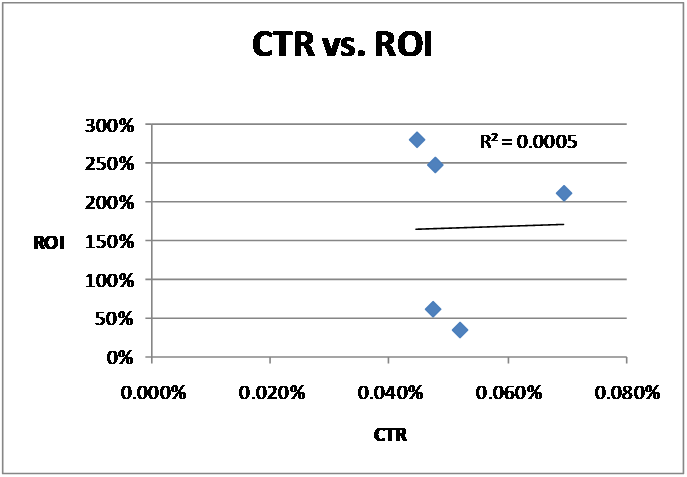
The article includes a priceless quote from John Lowell, Starcom USA SVP and director, research and analytics, “A click means nothing, earns no revenue and creates no brand equity. Your online advertising has some goal—and it’s certainly not to generate clicks.”  Don’t mince words John.  Tell us what you really think.  We’ve seen the same with our own offline sales measurements, by the way.  CTR is not even remotely correlated with offline sales lift or associated campaign ROI.  Here’s an example of the lack of correlation from some recent campaigns:

CTR vs. ROI

Reading Lowell’s quote and considering the fact that this is still even a topic for discussion reminded me of Monty Python’s famous Parrot Sketch.

Advertiser: “I know a dead metric when I see one and I am looking at one right now.”

DR Network: “No, no it’s not dead.  It’s just resting.”

“Offline Metrics” Work Online Too

Still digging out of my baby-induced blog backlog and came across an interesting MediaPost article by Adam Kasper of Media Contacts.  He basically poses a challenge to the online media industry to pull together and come up with an online GRP.  This theme is echoed in a recent (and fantastic) whitepaper from Microsoft’s Atlas Institute, which gives a more comprehensive treatment along with some practical suggestions.

Development and use of online metrics comparable to those routinely used in offline media is an extremely important topic.  As Kasper points out, comparable metrics make it easier for marketers to follow their audiences online.  That’s for sure (and we still have a lot of work to do there), but there are also some practical reasons why these tried and true top of the funnel metrics are as important online as they are offline.  First off, keep in mind that nearly 90% of retail commerce still occurs offline (even higher in some key ad categories like CPG).  Offline sales simply do not generate the same volume of online-actionable direct metrics that, for example, a company like NetFlix does.  So there’s a real practical limit to the in-flight optimization that can be done for marketers whose supply chains terminate offline.  Concepts like composition, reach and frequency are still tremendously useful tools in this environment.  Secondly, for many campaigns more precise targeting may not valuable and/or may not be available at scale.  Privacy issues aside, I’m not sure that “laundry detergent purchase intender” targeting gets you much further than “women, 25-54 with children at home” does.  But I am sure that it’s more expensive and offers smaller scale.  These points are just a brief treatment of an issue I have written on at length in the past.

The bottom line is that, even though less sexy, these “offline metrics” can be just as useful online and we shouldn’t be ashamed of using them.  Brand.net has shown that quality media, tight management of frequency, maximized composition and full budget delivery drive measurable results at the cash register.  That’s sexy enough for me.

The Bottom Line is Online Ads Work for Branding and Sales

Last week MediaPost picked up a press release on some comScore research showing that online ads can be effective in driving offline sales.  Just as effective as TV in fact.  This came as no surprise to us at Brand.net.  We have seen similar results in our work with clients measuring offline sales impact in response to online campaigns.

This recent release apparently builds on some earlier research discussed by comScore Chairman Gian Fulgoni in his keynote to the OMMA metrics conference in San Francisco at the end of July (covered in another MediaPost article, from which I borrowed my headline).  In his remarks, Fulgoni gave some rough treatment to CTR (similar to a post last week from Cory Treffiletti).  I was on panel at the same OMMA conference.  The panel focused on Brand measurement and the moderator (Dan Beltramo from Vizu) asked each of the panelists to answer a few questions to get the conversation started. One of the questions was, “What is the most misused metric for Brand Campaigns?”. All 4 panelists including yours truly answered, “CTR.”, to which Dan readily agreed. The fact is CTR isn’t correlated with attitudinal measures that Vizu focuses on. Nor is it correlated with ROI as measured by offline sales impact vs. online campaign spend.

The moral of the story is that well-executed online advertising delivers results throughout the marketing funnel and those results come through in the metrics, when the metrics applied are meaningful.

Thoughts on the latest OPA report

A blockbuster report from the OPA late last week, at least if one were to judge by how it lit up the blogosphere (as AdExchanger humorously put it, “Is the OPA the greatest link baiting organization in advertising, or what?”).  I reviewed some of the coverage and the report itself over the weekend and I have to say, with all due respect to the OPA and its members, this report doesn’t measure up to their previous efforts.

Here’s my take:

1) Most networks are focused on DR metrics and not the upper-funnel branding metrics that are the focus of the OPA study.  So even if we stop right there, it’s not shocking that that the study shows weaker results for networks.  This difference in focus is fundamental to Brand.net’s business by the way.  Unlike other networks, the Brand.net platform offers a  full suite of capabilities designed from the ground up to help brand marketers leverage the web to reach their audience efficiently and effectively drive these upper-funnel metrics.

2) The OPA report didn’t include or consider cost data.  If you believe the >10:1 spread between publishers’ direct and network deals cited in last year’s IAB research, this is a critical omission.  OPA pubs performing 50% better than networks doesn’t look so good in the context of a >10:1 price ratio.  Obviously the devil’s in the details here – the IAB research isn’t perfect either for reasons I have discussed previously on this page – but it’s clearly perilous to draw the sweeping conclusions OPA is going for without considering costs.

3) I don’t wish to cast aspersions on the study or methodology overall, but a couple of the data points just seemed counterintuitive to me.  For example, slide 19 of the OPA results deck states that ad networks deliver insignificant improvements in purchase intent for the financial services category.  This particular point caught my eye, because I know that well over $1B has moved through ad networks from hundreds of financial services companies over the past 5 years, the vast majority of which has been measured on a CPA – as in actual purchases, not just purchase intent.  It’s extremely hard for me to believe this money would have continued to flow in such volume over such a long time period if it wasn’t actually driving purchases.  If you agree, then we’re left with only 2 possible explanations: a) the data referenced to make this point is somehow not representative or b) purchase intent as measured by DL was not correlated with actual purchases.  Neither is particularly comforting.

4) In addition to the metrics OPA focuses on in this report, I would have liked to see an analysis of actual sales lift – i.e., the ultimate result that improvement in the attitudinal metrics discussed in the report is intended to drive over the long term.  This certainly isn’t easy for every client on every campaign, but it’s a powerful capability that proves real business results for many.  For the next study I would be interested in seeing similar data from OPA.

Some of these thoughts have already been expressed by others, including some who commented directly on WSJ’s coverage of the report, but I thought there was enough new here that it was worth joining the discussion.

Let me know what you think.