More on GDN Reserve

Today’s Ad Exchanger published more commentary on Google’s GDN Reserve announcement last week.

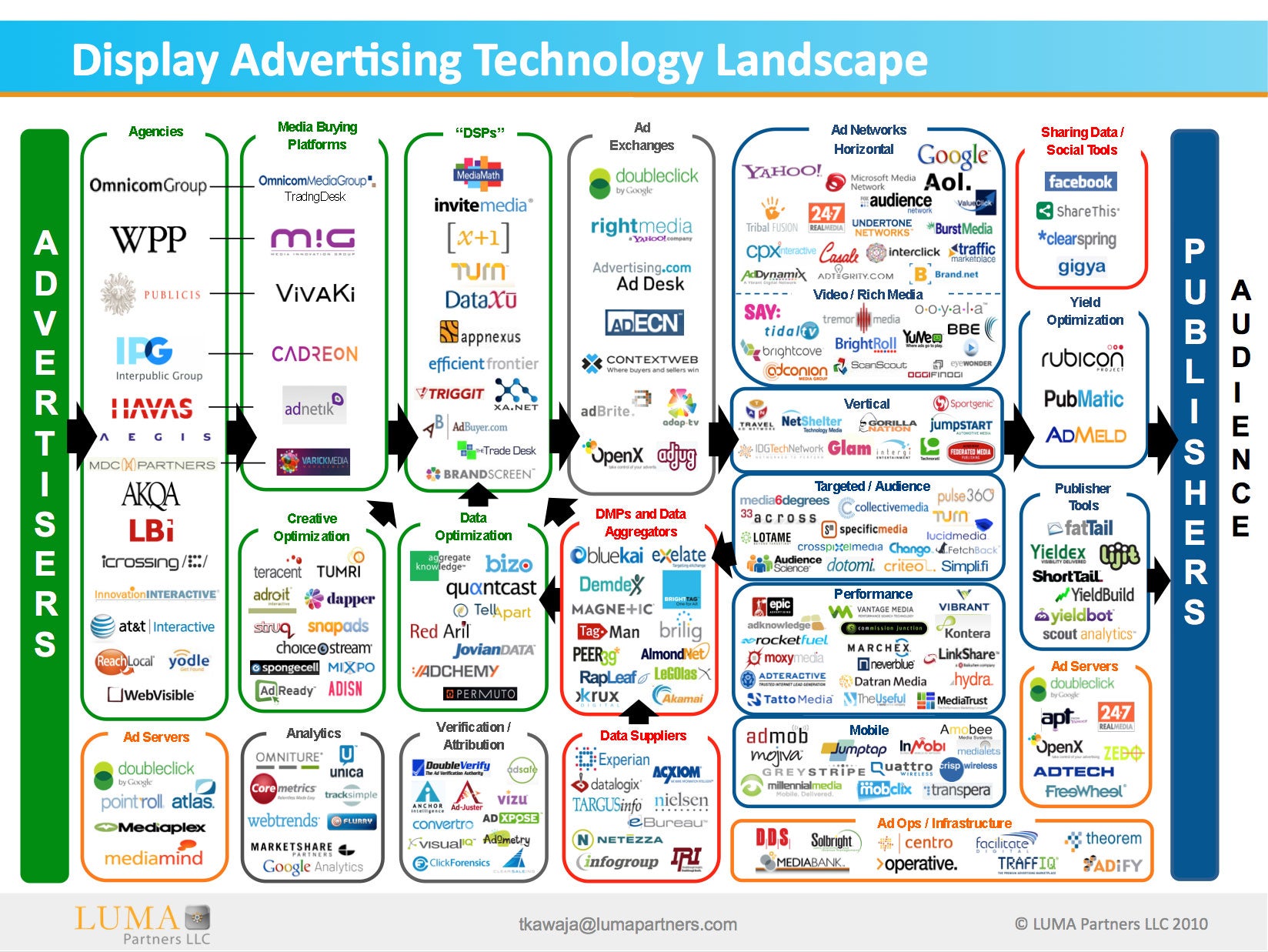
Views from senior execs at VivaKi (Publicis) and Group M (WPP) rounded out the additional commentary from Google that was posted Monday.  John also published some additional perspective from Elizabeth and others.

A few things in the various posts caught my eye.  One was simply the difference in perspective between Publicis and WPP – clearly two different strategies at work there.  Another was the refinement in Google’s messaging between the earnings call last week and Monday’s spokesperson (PR) commentary.  Seemed like a careful balance between agency and advertiser in the messaging this time around (what frienemy?).  I also thought VivaKi’s mention of Yahoo! in this context was interesting.  Y! was once the dominant global player in online branding and reserved display marketplaces.  I would have expected more from them sooner, but it’s nice to see the old alma mater at least in the game.  If there’s any road back for Y!, this is it.

I’ll close with a quote from VivaKi’s Curt Hecht:

“While our spending continues to grow in the spot marketplace, clients and publishers still desire the controls and forecasting offered in a guaranteed market around context, price and performance.”

I couldn’t have said it better myself.

This being my 100th sermon from the Brand.net pulpit, it’s nice to see the gospel is spreading.

Hallelujah!

Google launches Display Network Reserve

John Ebbert of AdExchanger and we here at Brand.net noticed the same thing on Google’s earnings call last night – the launch of Google Display Network Reserve, “which gives advertisers the opportunity to buy premium inventory on a guaranteed basis.”

This is interesting for a couple reasons.

First, it’s a clear signal that Google understands where the growth will come from in the display market:  large brands moving traditional media budgets online to follow their customers.  eMarketer laid out the case in December and it’s clear Google understands and agrees; Google launched the guaranteed product because “it’s how brand advertisers are telling us they want to buy inventory.”  We’ve been hearing the same thing loud and clear.

Second, to anyone that still had any doubts about Google’s commitment to or progress in Display:  Wake Up.  Since acquiring DoubleClick 4 years ago this week, Google has moved in a fast, focused way  to lock up all the key pieces of the transactional infrastructure for Display.  They haven’t been shy about it , especially over the past year, but I still don’t think the market fully appreciates how close they are to the endgame:  extending the hammerlock they have on Search to all elements of the Display market.  Scalable, efficient forward buying is the last piece of the puzzle.  It has been Google’s soft underbelly, but they are clearly doing sit-ups like crazy.

It’s crunch time.  AOL, Microsoft and Yahoo!:  If you’ve got a second wind in you, now’s the time.  Accenture, Adobe, Akamai, Apple, Cisco, IBM, Oracle and others:  If you’re serious about bringing your expertise in enterprise class infrastructure and service to the huge advertising market, your opportunity is slipping away.  And Agencies:  I agree with John’s emphasis on the particular phrasing of the announcement.  Don’t let frienemy Google steal a march on you.  If they take the Brand business client direct, that’s a big problem.  Microsoft has Windows and Office to fall back on.  You don’t.

It’s amazing how fast this market is moving.

Dogs eating the dog food

For those of you that missed our joint presentation with Del Monte at Ad Tech San Francisco yesterday AM, here are the slides Doug Chavez and I presented.

The top line is that $200K of Brand.net-managed media drove $1.5M of incremental offline sales for Del Monte’s Kibbles’n’Bits brand.   That’s an additional 2.2 million pounds of dog food sold due to this campaign alone.  That much dog food would fill a bumper-to-bumper caravan of semi-trailers stretching from the Empire State Building to the Bryant Park Hotel – more than a half mile.

Tangible evidence indeed that Brand.net’s Media Futures Platform delivers tremendous results for many of the world’s largest marketers.

Consolidation curve?

An insightful post from investo-blogger Jerry Neumann yesterday on Ad Exchanger.  I like what he’s thinking about in the post and agree with much of it, but there’s an important meta-point that he didn’t mention.

Jerry’s first point was that there is a huge shortage of experienced talent in the online ad industry and what does exists is primarily clustered within the myriad tech vendors in the ecosystem.  Agree.  His second point was that even as the exchange ecosystem (which at its core promises increased efficiency through a common set of pipes) grows, we see continued fragmentation of supply / demand relationships.  Agree.

But I would also argue that these two observations are causally related.  The reason things continue to fragment is largely that there are too many tech companies making too many pitches to too many media buyers and sellers that are still coming up the learning curve.  Tech company convinces still-learning buyer or seller to participate in “private market” promising some advantage in terms of functionality or monetization.  Careful A/B testing is hard to do without committing even more limited time/resources (hence it’s rarely done at all).  Whatever advantage was expected may or (more likely) may not actually be delivered, but such decisions are infrequently revisited.  As a practical matter, once the sale is made the arrangement has tremendous inertia, regardless of relative value add.

So Jerry’s “thin exchange standards” may well become necessary, but I think that would have much more to do with folks not thoughtfully using the tools that already exist rather than a “real” need.

“Private markets” are rarely the most efficient alternative.  The more participants in the market the better, assuming careful thought is given to structure and business rules.  I saw frequent examples of the private market dynamic in my time at Yahoo!.  Some enterprising salesperson would convince a content group GM to dedicate a placement to a particular advertiser.  Such arrangements almost always under-monetized relative to an open, competitive market for the same placement.  There was just an article last week in the ‘Journal offering up some more evidence from Goldman’s experiment with private markets.    Or coming at it from another angle, have you ever tried to sell anything locally on craigslist, failed, then posted on eBay?  eBay’s national market with huge liquidity almost always closes the deal at a fair price.

The faster we collectively get up the learning curve, the faster things will consolidate so we can actually realize some of the efficiency gains we’ve all been chasing.